
CUSP Markets
Permissionless, isolated capital markets for outcome-linked assets, with credit written on short repriced terms.
CUSP Markets are permissionless, isolated capital markets for outcome-linked assets. Within a market, CUSP lends against live positions, but never on a single floating rate set and forgotten. The terms are written to how the collateral is actually moving, and rewritten as it moves.
What a CUSP Market defines
Each CUSP Market fixes its own terms at creation:
- collateral asset;
- borrow asset;
- underlying venue;
- resolution source;
- loan duration;
- interest-rate model;
- maximum advance rate;
- exposure limits;
- risk module;
- liquidation method;
- settlement route.
A market for a liquid macroeconomic contract can use different limits and liquidation rules from a market financing a thin election, sports, or conditional claim. Capital providers funding a market know exactly which collateral, parameters, and settlement risks they are supporting.
Isolation in CUSP is a risk boundary, not a capital boundary. Every market contains its own collateral and default risk, and CUSP Vaults aggregate capital across markets without pooling solvency: a loss in one market never reaches another market's balance sheet through a shared pool.
Short terms, repriced often
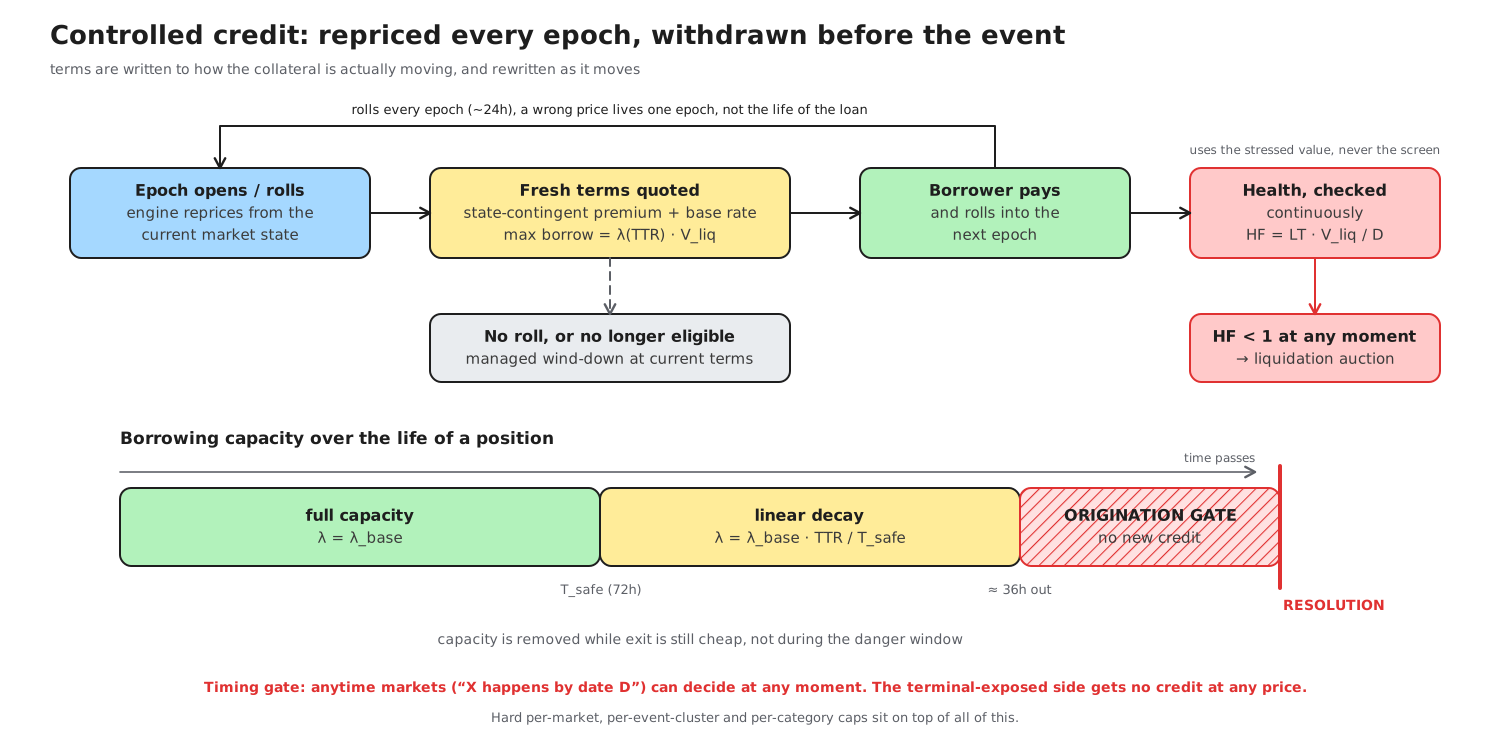
Credit is written in short epochs. At each rollover the risk engine reprices the collateral from current market state, and the loan either continues on fresh terms or unwinds because the position no longer qualifies. Pricing tracks the position in close to real time instead of drifting behind it on a curve that was right last week.
Each rollover quotes a state-contingent premium with a published decomposition: expected loss, a tail-risk margin, and a base rate. The price is not a single opaque number but a breakdown an integrator can read and check.
Health factor
A loan's health compares stressed collateral coverage to what is owed:
In one line
Health compares what the collateral is worth under stress to what is owed, and the comparison uses the stressed value, never the displayed price.
Below 1, the loan is open to liquidation. This is the same coverage measure every serious lending protocol publishes. The difference is entirely in the inputs, which are built for event collateral rather than for spot.
Capacity decays, then the gate closes
Borrowing power is not constant across a position's life. It is full while resolution is far off and falls as the event nears:
In one line
Borrowing power is full while resolution is far away, shrinks steadily inside the safety horizon, and is switched off completely just before the market resolves.
In practice it works in three phases:
- Far from resolution: full capacity.
- Inside the safety horizon: capacity winds down toward zero.
- Right before resolution: the origination gate stops new credit
entirely. The gate sits at
TTR < epoch + buffer, about 36 hours on the launch route.
So you cannot open a fresh loan the morning the market is about to decide, which is exactly the window where the collateral can gap to zero. Hard exposure caps bound total borrowing per market on top of all this.
This timing protection only reaches fixed-date markets. An anytime market can decide on any morning, not just near a known date, which is why its terminal-exposed side gets no credit at any price under the timing gate in CUSP Risk.
Term boundaries
Every loan has a fixed duration. At each boundary it rolls into a new term at freshly published risk parameters, reduces if borrowing capacity has declined, or repays if the market no longer supports credit. Credit against a resolving asset is never open-ended: successive terms shorten as resolution approaches, advance rates decay, and new borrowing stops at the resolution buffer.
Escrow and non-recourse servicing
Collateral sits in protocol escrow from the moment the loan opens. Debt can be serviced directly from escrowed collateral: mid-term shortfalls are cured through small time-sliced sales from escrow, and terminal wind-downs run through CUSP Clear. If an unwind falls short, the loss stops at the market's capital. CUSP credit is non-recourse: shortfalls never reach the borrower's wallet.
Market types
Three market types run on this machinery:
- Standard credit lines: credit against live positions, the mechanism this page describes.
- Settlement advances: credit against resolved, unsettled claims, where the term equals the settlement lag.
- Maker facilities: planned, restricted to verified market makers, with controlled accounts and approved strategies.
At launch, market creation is limited to approved curators. Creation opens permissionlessly as the risk standard and the clearing network accumulate live performance history.
Why go to this trouble
A single floating rate quietly assumes risk that changes slowly. Event positions do the opposite: their risk is mild for most of their life and then concentrates sharply into the moment of resolution. Repricing per state, per epoch, and pulling capacity before the event is what keeps the credit solvent through that concentration. The parameters behind the decay and the gate are in the CUSP whitepaper.
And when the underlying market settles while a loan is open, nothing has to be chased: settlement proceeds repay principal first, then interest and fees, and the remainder returns to the borrower. A credit line that settles itself when the market does.