
CUSP Risk
The shared underwriting standard that values event positions at stressed recoverable value, gates eligibility, and publishes a reproducible risk vector.
CUSP Risk is the shared underwriting standard for event-driven collateral: the measurement layer every other CUSP layer reads from. Its risk engine takes the venue's authoritative record for a position and returns a stressed, reproducible view of what that position is worth and whether it can be supported at all.
The engine never values a position at the price on screen. It values it at what the position would actually recover under stress.
A YES claim at 70 cents is a market price, not a 70% truth about the world. The engine does not ask how likely the event is. It asks what the position recovers if it has to be sold in a hurry, into the worst conditions that tend to arrive with the bad news.
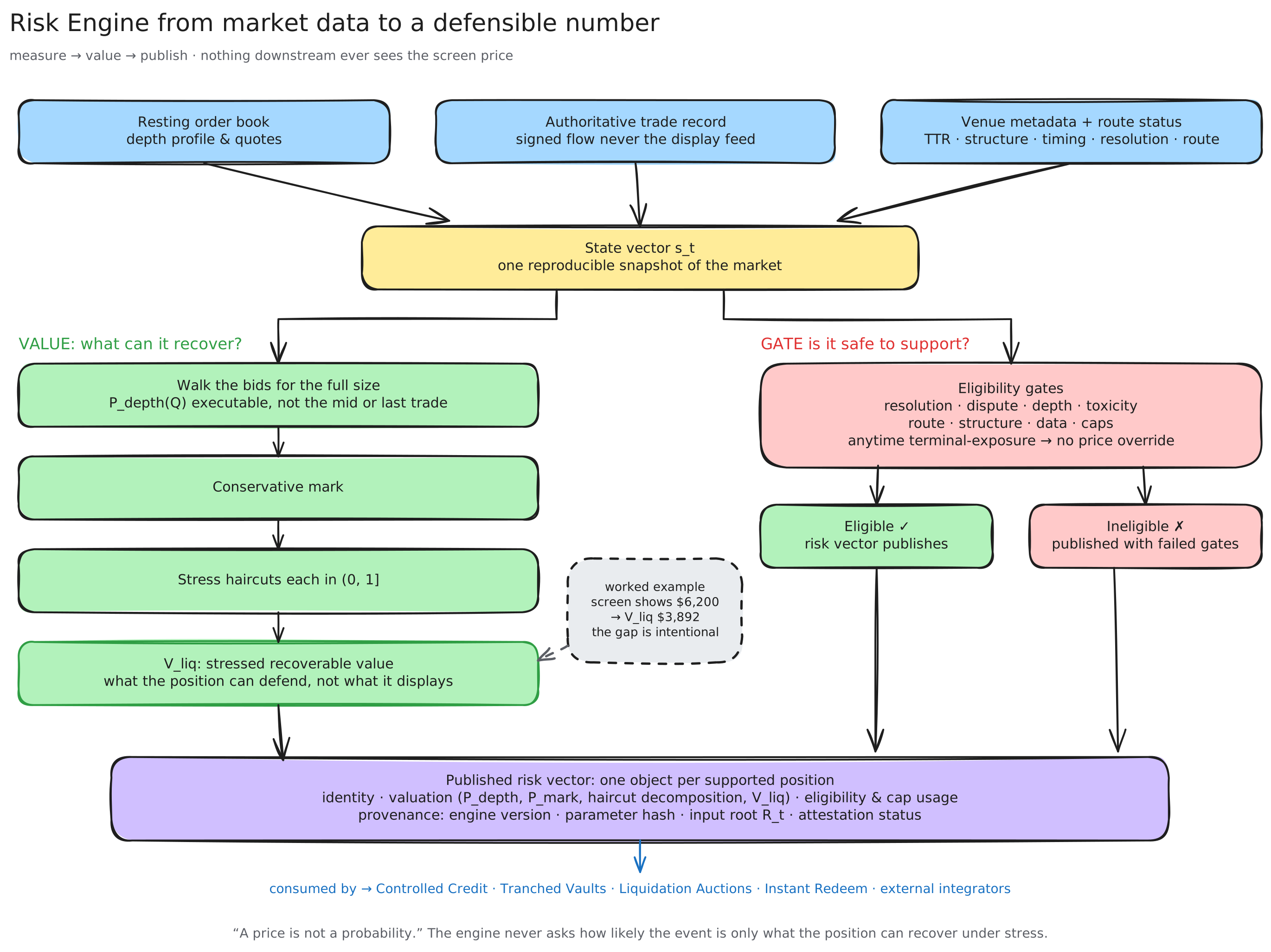
What it reads
The engine works from authoritative sources only, never display feeds.
- The resting order book, for real depth and the price the full size can exit at.
- The authoritative trade record, for price history and signed flow.
- Venue and market metadata, for resolution source, timeline, and structure.
- Route status, for redemption latency, freezes, and incident history.
Signed flow comes from the record, not the feed
Trade direction is taken from the authoritative record, never inferred from a display feed. A feed can show a resting book, but signed-flow risk has to be computed from what actually traded.
How it marks
The engine never trusts a single number. It marks in three steps, and each step can only make the value more conservative, never less.
1. Executable depth: the price the size can actually exit at.
The engine walks the live bid book for the full position and takes the volume-weighted price it would receive selling all of it:
This is what the position fetches in the market that exists, not the top bid, the mid, or the last trade. A large position pays for its own exit.
2. Conservative mark: the worst of independent estimates.
The mark is the lowest of the executable price, a trailing average from the authoritative trade record, and a cross-venue reference where a reliable one exists. A stale or printed-up last trade is never an input.
3. Stressed value: the mark, discounted for event-collateral risk.
Each haircut sits in (0, 1], so each one can only pull the value down, never
lift it.
| Haircut | Penalizes |
|---|---|
H_liq | Thin or top-heavy depth |
H_tox | Adverse, one-sided flow that looks informed |
H_res | Human judgment over mechanical settlement |
H_route | Redemption latency, freezes, or incidents |
V_liq is the stressed recoverable value. It is a valuation, not a borrowing
amount. What any layer does with it is decided elsewhere.
A worked example
Take a 10,000-unit YES position.
- On screen it shows a
0.62mid, so it looks like $6,200. - Walking the book for the full size gives an executable
0.595, already under the mid, because the order eats into depth as it fills. - The haircuts for this position come out at
0.85liquidity,0.90toxicity,0.95resolution,0.90route.
The screen says $6,200. The engine will stand behind $3,892. That gap is the whole point: it is the distance between what a position looks like and what it can actually defend when the news lands and the book empties.
The example numbers are illustrative
The haircut values above are for the walkthrough only. Live parameters come from the published, governed registry, not from a value set by hand per position. That is what lets anyone holding the inputs reproduce the same mark the engine did.
When a market is ineligible
Some markets cannot be valued safely at any price. The engine refuses them rather than publish a number it would not stand behind.
| Gate | Fails when |
|---|---|
| Resolution | Too close to resolution, or inside determination |
| Dispute | Disputed, paused, or under review |
| Depth | The book cannot support a defensible exit for size |
| Toxicity | Signed flow is too one-sided or adverse |
| Route | Redemption diagnostics deteriorate |
| Structure | Structure-specific checks fail |
| Timing | The held side is terminal-exposed in an anytime market. Structural, no price override |
| Data | Authoritative data is stale, missing, or inconsistent |
| Cap | An exposure limit is reached |
Structure and timing
How a claim pays, and when it can pay, change how it is marked.
| Structure | Treatment |
|---|---|
| Binary | Full cliff risk; can trade near full value and still settle at zero |
| Categorical | Hold every outcome and they cancel; only the leftover net position is marked |
| Strike ladder | Prices kept in order across the levels; each rung still carries cliff risk |
| Scalar | No sudden drop to zero, so it makes higher-quality collateral |
| Conditional | Payout case and refund case marked separately |
Timing cuts across all of them. A fixed-date market is read at a known date and is underwritable on the standard machinery. An anytime market can resolve on any morning, so no time-to-resolution rule can protect the side an early arrival zeroes out, for example NO on "X happens by Dec 31". That side gets no credit at any price, and ambiguous resolution criteria are treated as anytime, conservatively.
Concentration caps
The engine tracks correlated exposure so a set of individually acceptable positions cannot quietly become one risk. Caps apply per market, per event cluster, per category, per counterparty, per route, and per resolution window.
What it publishes
For each supported position the engine publishes one reproducible risk vector, carried to integrators as the Outcome Risk Object:
- Identity: market, venue and route, structure, resolution source.
- Valuation: executable price, conservative mark, haircuts, stressed value, toxicity, time-to-resolution band.
- Eligibility: verdict, any failed gates, cap usage.
- Provenance: engine version, parameter hash, timestamp, input commitment root, watcher-quorum attestation status.
Anyone holding the published inputs and the parameter registry can reproduce it.
Tightening applies at once; loosening needs attestation
Outputs that tighten risk (a lower mark, a closed gate, a cut cap) apply immediately on the operator's signature. Outputs that loosen it need independent watcher-quorum attestation first, and integrators should refuse a loosening move that arrives without it.
An open surface, not a proprietary model
Marks and parameters are published, not proprietary. CUSP Risk publishes marks through oracle networks, exposes every Outcome Risk Object through an open API, versions each parameter change, and maintains a public calibration record comparing stressed values against realized outcomes. The standard is auditable from its first day, and its history cannot be reproduced by anyone who starts later.