
CUSP Vaults
Curated strategies that allocate capital across approved CUSP Markets, with senior and junior tranches sharing income and losses.
CUSP Vaults are curated strategies that allocate capital across approved CUSP Markets. Most depositors will not want to evaluate every market, resolution rule, risk model, and liquidation route individually; a vault delegates that work to a curator without pooling solvency across unrelated markets.
The curator model
Independent curators run each vault. A curator:
- selects eligible CUSP Markets;
- defines exposure caps;
- allocates and rebalances capital;
- maintains withdrawal liquidity;
- monitors performance;
- removes markets that no longer satisfy the vault's mandate.
Example strategies show the range the model supports:
- CUSP Prime Vault: conservative exposure to liquid macroeconomic, regulatory, and major election markets with strict collateral and concentration limits.
- CUSP Market Maker Vault: restricted capital facilities for verified liquidity providers using controlled accounts, first-loss capital, and approved market-making strategies.
- CUSP High Yield Vault: higher-yield exposure to thinner or less mature markets with lower advance rates, stronger reserves, and stricter loss limits.
Sophisticated lenders can bypass vaults entirely and fund individual CUSP Markets directly.
The tranche structure
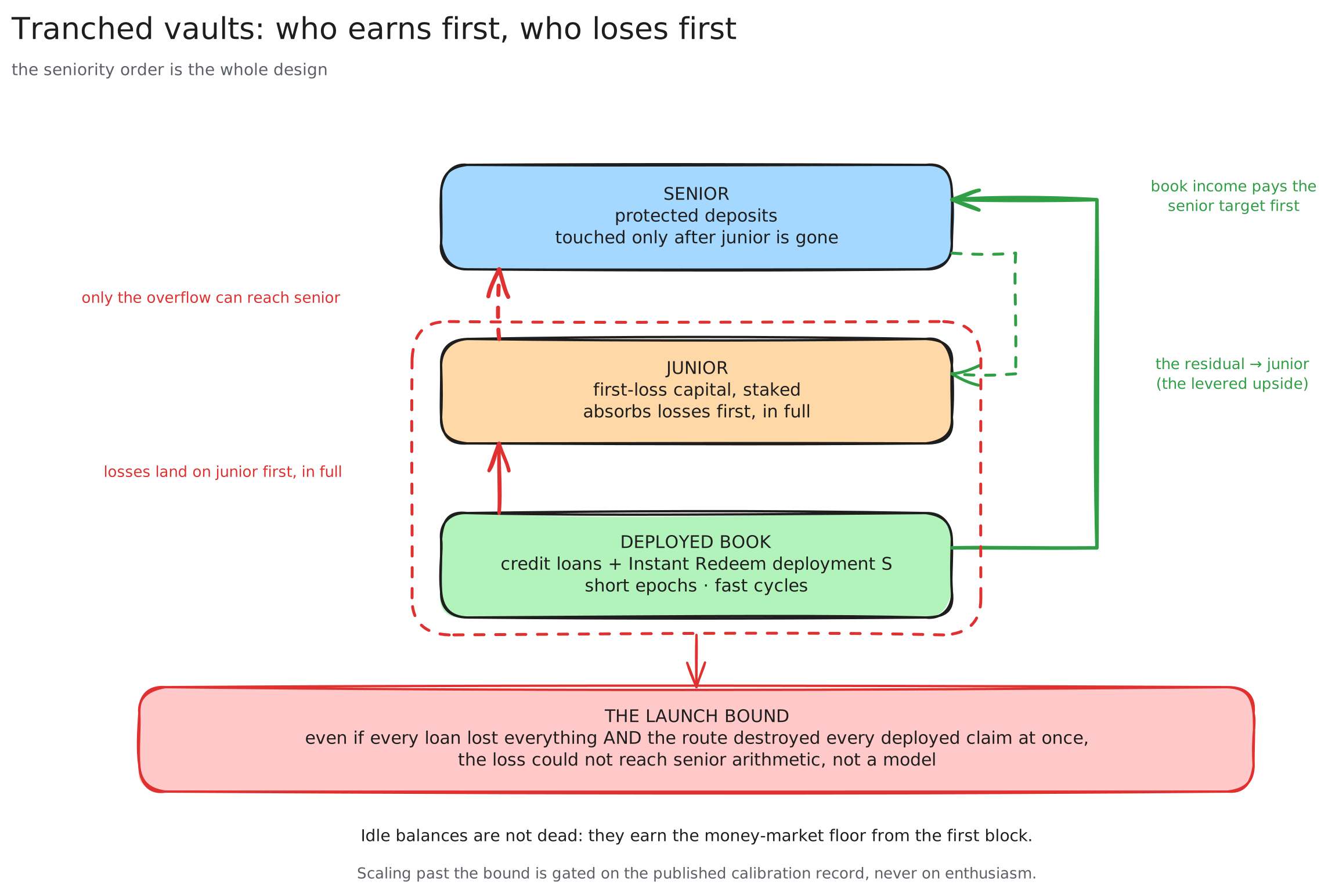
Within a vault, capital is split into two tranches with a fixed order of seniority. That order is the whole design: it decides who earns the steadier return and who stands in front of the losses.
The two tranches
| Senior tranche | Junior tranche | |
|---|---|---|
| For | Protected, lower-volatility income | First-loss capital seeking yield |
| Loss order | Touched only after junior is exhausted | Absorbs losses first, in full |
| Return | Steadier base income | The levered residual |
Senior capital sits behind the structure. Junior capital is staked first-loss money, and its higher yield is the price of standing in front, not a perk.
When losses hit
Losses move through the structure in one direction. Junior absorbs them first and in full; senior is reduced only once junior is gone:
In one line
Losses land on junior capital first and in full; senior deposits are touched only after junior capital is completely gone.
Income runs the opposite way. Senior's claim is met first, and junior keeps the levered residual that is left, which is what compensates it for taking the hit when one comes.
Idle capital still earns
Balances not deployed into credit do not sit dead. Idle capital earns a base money-market rate from the first block, so depositors are paid while the protocol waits for eligible demand rather than only once it arrives.
The launch bound
At launch, credit and settlement deployment share the same first-loss envelope. The bound is joint: total loans plus the assumed loss on deployed claims is capped by junior capital.
In one line
At launch, lending and settlement deployment together are capped at junior capital, so even if every loan defaulted at zero recovery and a route event destroyed every deployed claim at the same moment, the loss could not reach senior depositors. No model or estimate is involved; it is arithmetic.
This is the strongest thing the design can say to a senior depositor: at launch, your protection does not rest on anyone's model being right. It rests on a sum being smaller than another sum.
The protocol scales past this bound only as fast as its published calibration record supports. The formal treatment is in the CUSP whitepaper.