
Supported Structures
The payoff structures CUSP Markets can be created for, and how each is treated as collateral.
These are the payoff structures CUSP Markets can be created for. CUSP is not a binary-only system. The engine recognizes five payoff structures plus a timing class, and changes treatment for each, because how a claim pays, and when it can pay, decides how it behaves as collateral.
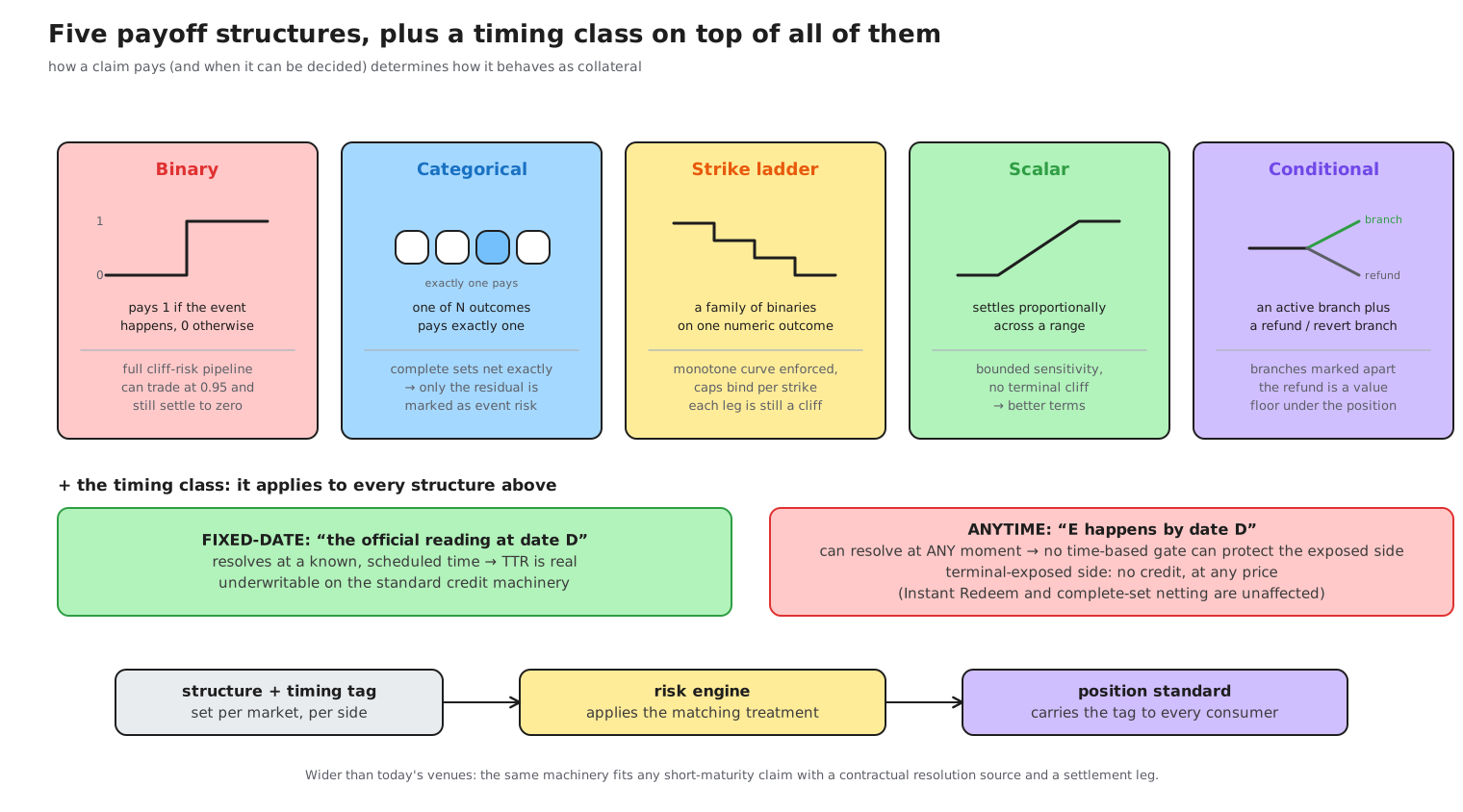
| Structure | What it is | Collateral treatment |
|---|---|---|
| Binary | One yes/no event: pays in full, or nothing | Treated as full cliff risk, since it can drop to zero in one step |
| Categorical | Several outcomes, exactly one pays | Hold every outcome and they cancel out; only the leftover net position is marked as risk |
| Strike ladder | Yes/no claims stacked along one number, like price levels | Prices kept in order across the levels; risk tracks the one underlying number |
| Scalar | Pays on a sliding scale across a range, not all-or-nothing | No sudden drop to zero at the end, so it makes higher-quality collateral |
| Conditional | Pays only if a prior condition holds, otherwise refunds | Payout case and refund case valued separately; the refund sets a value floor |
These distinctions are not cosmetic. Letting a full set of outcomes cancel out can raise borrowing power on a balanced book many times over, compared with marking each claim on its own, and scalar claims earn better terms because they cannot suddenly collapse to zero.
The timing class
Timing cuts across every structure above. It asks not how a claim pays, but when it is allowed to.
| Timing | What it means | Effect on credit |
|---|---|---|
| Fixed-date | The outcome is read at date D | Underwritable on the standard machinery |
| Anytime | The event can resolve by date D, at any moment | The terminal-exposed side gets no credit at any price |
An anytime market can decide on any morning, so no time-to-resolution rule can protect the side an early arrival zeroes out, for example NO on "X happens by Dec 31". That side is structurally uncreditable, judged by the timing gate in CUSP Risk, not by its price. Settlement advances and complete-set netting are unaffected, since both are timing-independent.
The scope is wider than today's venues, too. The same machinery fits any short-maturity claim that resolves against a contractual source and pays out after the fact, and CUSP is built for that wider class of outcome-contingent assets, not for one contract shape on one kind of venue.
CUSP Risk applies these treatments when it marks a position, and the Outcome Risk Object carries the structure tag so any consumer treats the claim correctly.